
Systems & Processes
B2B Commerce Should Learn From B2C. Not Copy It.
B2B orders often start in a buyer's ERP, with a rep, through EDI or ecommerce. Why reducing buying friction matters more than forcing one portal.
The short answer
B2B should copy B2C's obsession with reducing friction, not its assumption that every order should begin in a storefront. In repeat B2B purchasing, the commercial decision, replenishment decision and order itself can happen at different times and in different systems. The best order process accepts the transaction where it naturally starts.
In this article
The biggest mistake in B2B ecommerce is assuming the order starts on your website.
B2C ecommerce spent more than two decades making it easier to buy. Fewer steps. Better product discovery. Faster checkout. Less information to re-enter.
B2B should copy that obsession with removing friction, not necessarily the storefront model.
For distributors, wholesalers and manufacturers selling repeatedly to retailers, the commercial decision, replenishment decision and individual order can happen at different times and in different systems.
Once the purchasing decision has been made, the real job is simple:
Turn it into a valid order with as little duplicate work as possible.
Sometimes that decision happens in the buyer’s ERP. Sometimes online. Sometimes with a rep in the store. Sometimes through EDI.
That changes what friction actually means.
The PO is often not the buying decision
By the time a purchase order arrives, a large part of the commercial decision may already be behind it.
When a retailer agrees to carry a brand or a distributor adds a supplier, products have already been presented. An assortment may have been selected. Pricing, pack sizes and commercial terms have been discussed. There may be an opening order, promotional commitments or agreed locations.
GS1 makes an important distinction here. Product listing is the decision by a commercial organization to adopt a product into an assortment, and GS1 describes that listing as the result of commercial negotiations between purchaser and seller.
The individual order comes later.
Once that relationship is established, the question is often no longer:
Do we want this product?
It becomes:
How much do we need now?
That quantity may be determined by inventory, sales velocity, open orders, lead time, promotions, forecasts or the retailer’s replenishment process.
A recurring B2B order is not necessarily another shopping journey.
Sometimes it is simply the execution of a decision already made.
The real job is getting from decision to valid order
How much work sits between the customer’s decision and a usable order inside the supplier’s operation? That is a better starting question than how to get more buyers onto a portal.
A lot of B2B commerce technology starts with:
How do we get more customers to use the portal?
I think there is a better one:
How much work sits between the customer’s decision and a usable order inside our operation?
Imagine a retailer that already carries 40 of your products.
Its purchasing process reviews what has sold, determines what needs replenishment, generates a 40-line PO and routes it for approval.
The transaction is ready.
If the buyer then has to log into your portal, find the same 40 products and enter the quantities again, something strange has happened.
From the supplier’s perspective, order entry has been digitized.
From the customer’s perspective, the order-entry job has simply moved to them.
B2C taught us to remove work
The B2C lesson worth copying is not “put everything through ecommerce.” It is “don’t add a step unless the step creates value for the buyer.”
Consumer ecommerce has spent decades reducing the amount of effort required to complete a purchase.
That is the lesson worth copying.
Baymard’s checkout research found that 19% of surveyed users abandoned a checkout when forced to create an account, while long or complicated checkout processes remain another measurable source of abandonment.
The exact buying behavior is different in B2B, but the operating principle carries over:
Don’t add a step unless the step creates value for the buyer.
If ecommerce helps someone discover products, build an order and purchase more easily, excellent.
If the buyer has already created the transaction somewhere else, asking them to recreate it is not simplification.
The B2C lesson is not:
Put everything through ecommerce.
It is:
Remove unnecessary work from the customer.
There isn’t one place where a B2B order starts
B2B orders start where the purchasing decision happens: in a buyer ERP, ecommerce, with a field rep, through EDI, or from replenishment logic. The same customer may use more than one.
The more useful question isn’t:
How do we get every customer onto our portal?
It is:
Where does the purchasing decision actually happen?
There are several legitimate motions:
- Buyer initiated: the retailer or distributor creates the requirement in its ERP, purchasing system or spreadsheet and sends a PO.
- Self-service: the buyer browses the assortment, discovers products, chooses quantities and creates an ecommerce order.
- Rep initiated: the purchasing decision develops during a store visit, call or account review.
- System initiated: replenishment logic identifies a requirement and proposes or creates the next transaction.
The same customer may use more than one.
McKinsey’s 2026 Global B2B Pulse survey, based on nearly 4,000 decision-makers across 13 countries, found that buyers use an average of ten channels across the purchasing journey.
Trying to reduce that reality to one mandatory front door may simplify the supplier’s architecture.
It does not necessarily simplify the customer’s work.
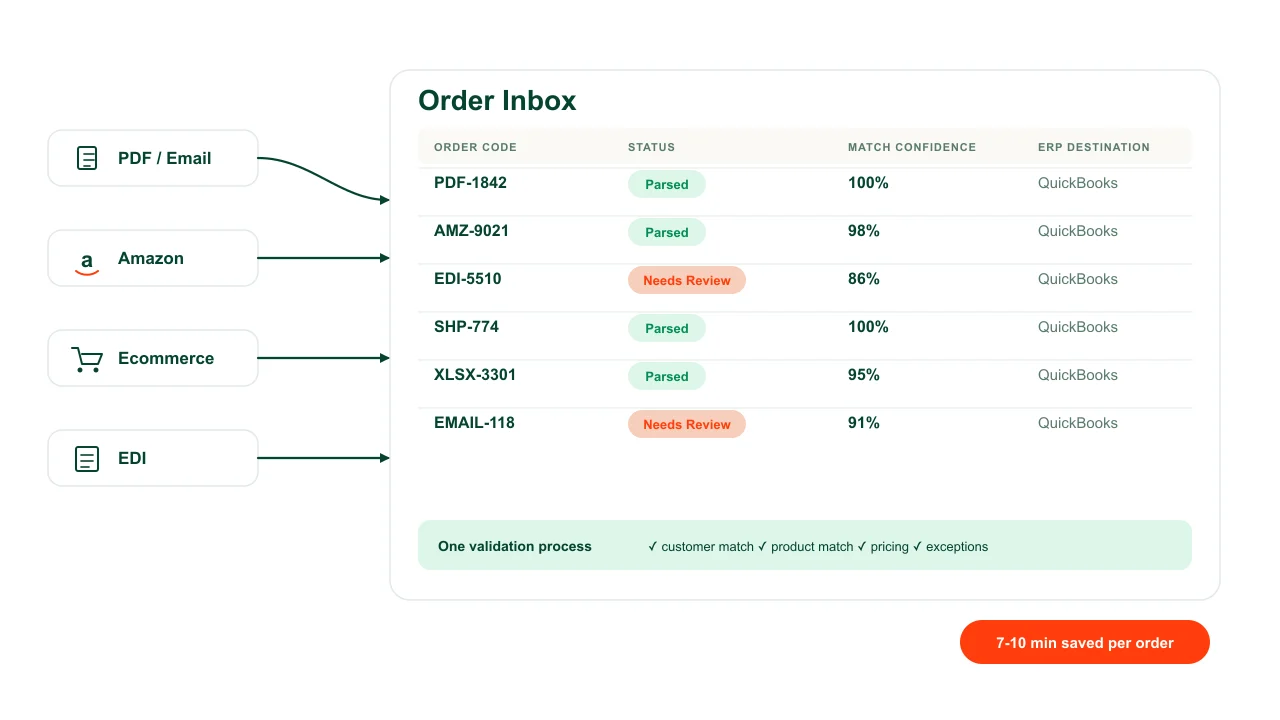
Many ways in. One operating process behind them.
Sometimes the rep is where the order starts
Not every B2B order starts with someone sitting behind a purchasing system. Sometimes it starts with a rep standing in front of the shelf.
This is especially important in CPG, food, beverage and repeat-purchase distribution.
The rep may already know what the account normally carries. They can see what is missing. They know a promotion is starting. They can see that an expected SKU was never introduced. They can discuss what needs replenishment and whether a new product belongs in the assortment.
The job in that moment is not simply entering an order.
It is answering:
What should happen in this account now?
This type of transaction is not theoretical. GS1 US documents Direct Store Delivery processes where, after a product has been accepted for distribution, the seller’s representative can visit the store, determine what product is needed and place or record the transaction.
A rep preparing for that conversation should not have to start from zero.
Purchase history exists. The assortment exists. Reorder behavior exists. Promotions exist. Product and account activity exist.
The rep’s job is to use that context to determine what deserves attention with the customer.
And if both sides agree on the order, there should not need to be another person entering the same decision later.
Capture the transaction where the decision happens.
I’ve had versions of this discussion for 25 years
When customers enter their own orders, the supplier may remove order-entry work. The better question is who lost work and who gained it.
When you’ve spent enough time implementing ERP systems, the technology changes but some conversations don’t.
One of them is:
“If customers enter their own orders, we won’t have to enter them.”
Technically, that is true.
But I think the better question is:
Who are we removing work from, and who are we giving the work to?
Years ago, I worked with a trailer manufacturer building a digital environment for its dealership network.
There was obvious value in putting information online. Dealers could find model information, learn about promotions and get information directly from the manufacturer.
Then came the natural idea: if they’re already using the platform, get them to place every order there too.
That required something very different.
Dealers needed accounts. People needed onboarding. They had to learn another process and remember another place to go.
For information, there was a reason to use the platform.
When it was time to transact, many still returned to the process they already had: PO, PDF, Excel or email.
We were asking the customer to change their operation so we could simplify ours.
Today, I would challenge that assumption much earlier.
The PDF isn’t necessarily the manual part
A PDF purchase order is often labeled a manual order. From the customer’s side, the transaction may already be complete. The manual work often begins when the supplier receives it.
A PDF purchase order is often described as a manual order.
But consider everything that may have happened before the PDF reaches you.
The customer’s system knows the products. Quantities have been calculated or entered. The order may have gone through an approval process. Their ERP generated the document. Someone sent it.
From the customer’s side, the transaction may already be complete.
Then your team receives it.
Someone opens the file, identifies the customer, reads every line, matches the customer’s item numbers to your products, checks quantities, reviews pricing, spots exceptions and enters the order into another system.
The PDF wasn’t necessarily the manual process. Receiving it was.
That is a much more useful distinction.
The same thinking applies beyond PDF.
One order arrives through EDI. Another through ecommerce. Another through email. Another originates with a field rep.
The real operating challenge is what happens after those transactions reach the supplier.
EDI got one principle right a long time ago
Don’t make someone enter the same transaction twice. That is the principle EDI got right, and it still applies when orders arrive as PDF, ecommerce, email or field sales.
GS1 describes EDI as the automatic transmission of business data directly from one computer application to another. Its documented benefits include reducing re-keying and improving the speed and accuracy of information exchanged between trading partners.
The underlying logic is difficult to argue with.
The buyer already has the transaction.
The supplier needs the transaction.
Why put a person between the two simply to recreate it?
EDI works particularly well where the trading relationship is structured enough to support it.
But many B2B businesses operate across a much messier mix of channels.
- Excel
- EDI
- Ecommerce
- Field sales
Different retailers use different combinations.
The transaction may be similar even when the way it reaches you is completely different.
Many ways in. One operating process behind them.
If orders naturally originate in multiple places, forcing all of them into one interface may be solving the wrong problem. The goal is to stop rebuilding the same operational work around every channel.
The operation behind those channels needs to understand what arrived.
- Who is the customer?
- Which products are they referring to?
- What quantities are requested?
- Which commercial and operational rules apply?
- Does something require review?
- Can the valid part move forward?
The goal is not necessarily to eliminate every channel.
The goal is to stop rebuilding the same operational work around every channel.
That is very different from:
“Everyone must use our portal.”
The portal still has an important job
A B2B portal creates value when buyers want to use it because it makes discovery, assortment, promotions or ordering easier. It should not become a toll booth between a purchasing decision and the order desk.
A strong B2B digital experience can create substantial value.
A retailer may want to discover a product, review an assortment, understand a promotion, access specifications or images, see purchase history or browse products they have not carried before.
For many smaller buyers, ecommerce can also be the easiest way to create an order.
That’s exactly when it should be used.
What I question is the assumption that because the portal exists, every transaction needs to pass through it.
A portal should be somewhere customers want to go because it makes part of their job easier.
It shouldn’t become a toll booth between a purchasing decision and your order desk.
B2B should copy the B2C principle, not necessarily the interface
Let the transaction start where the decision naturally happens, then remove unnecessary work between that decision and execution. The goal is many ways to buy, with one operation capable of understanding what happens next.
B2C optimized the storefront because that is where a large part of consumer purchasing happens.
B2B has another reality.
There are commercial relationships, negotiated assortments, retailer systems, reps, ecommerce, EDI, POs, replenishment processes, product mappings, promotions and fulfillment requirements.
Trying to make all of that look like consumer checkout does not make the complexity disappear.
The better principle is:
Let the transaction start where the decision naturally happens.
Then remove as much unnecessary work as possible between that decision and execution.
The buyer can create the PO.
The independent retailer can order online.
The rep can help determine and capture the order in the store.
Structured trading partners can use EDI.
The customer should not have to care that your operation receives each one differently.
The goal isn’t one ordering channel.
The goal is many ways to buy, with one operation capable of understanding what happens next.
Take the order where it starts.
Then automate what happens next.
Sources
- GTIN Management Best Practices: GS1
- How to Reduce Cart Abandonment: Baymard Institute
- B2B buyers reset the bar (2026 Global B2B Pulse): McKinsey & Company
- GS1 US Business Processes Guide for EDI (Direct Store Delivery): GS1 US
- What are the benefits of EDI?: GS1
Go deeper
Guide
PDF-to-QuickBooks Order Automation
How distributors, CPG brands, wholesalers and manufacturers turn emailed purchase orders into validated QuickBooks sales transactions.
Read guideGuide
Field Sales Software for CPG and Distribution
A practical look at account prioritization, product context, demand signals and the information field reps need before and during customer visits.
Read guideKeep reading

Systems & Processes
CPG merchandising: how to turn a retail listing into repeat orders
CPG merchandising connects product discovery, shelf availability and replenishment. To turn a retail listing into repeat orders, brands need to check in-store execution, distinguish sell-in from sell-through, and coordinate field support, inventory and retailer ordering around the selling opportunity.
Systems & Processes
Consumers Want More Value. That Doesn't Mean CPG Brands Need More Promotions.
Consumers are looking harder for value, but that does not automatically mean CPG brands should respond with more promotions.

Systems & Processes
Why Your Commerce Stack Can't Generate Decisions
Most businesses don't have a data problem. They have a decision architecture problem.
From insight to action
Your data already knows what changed.
Grabb turns customer, product, order and operational signals into a prioritized list of what your team should do next.