
Systems & Processes
CPG merchandising: how to turn a retail listing into repeat orders
Turn retail listings into repeat orders. Connect CPG merchandising, field sales, inventory and replenishment to help retailers sell through and reorder.

In this article
CPG merchandising connects product discovery, shelf availability and replenishment. To turn a retail listing into repeat orders, brands need to check in-store execution, distinguish sell-in from sell-through, and coordinate field support, inventory and retailer ordering around the selling opportunity.
Your product is launched. The retailer has accepted it. The first shipment has been dispatched.
But what happens when the next order takes longer than expected?
The reason for this may vary. Product may not have been stocked. Stock may have been removed from the shelves. The store personnel may not understand how the product should be merchandised.
The merchandising challenge for a CPG brand is to ensure the product is stocked, sold and available for replenishment. This includes understanding, evaluating and addressing the reasons for the loss of product velocity and ensuring that the product is sold.
This was the core of the discussion at CHFA NOW Toronto 2026, The Power of Merchandising, held on September 25, 2026 and moderated by Amanda Kenny. The discussion focused on various aspects of merchandising from demos and displays to brand storytelling.
The paramount question however remained, how does a product business strategize in a manner that it can execute commercial merchandising of the product and ensure repeat business?
What should a brand check before calling a SKU a slow mover?
A CPG brand should check availability, placement, price and execution before interpreting weak sales as weak demand. A SKU that was missing from the shelf or never received its planned display has not had the same selling opportunity as a fully supported product.
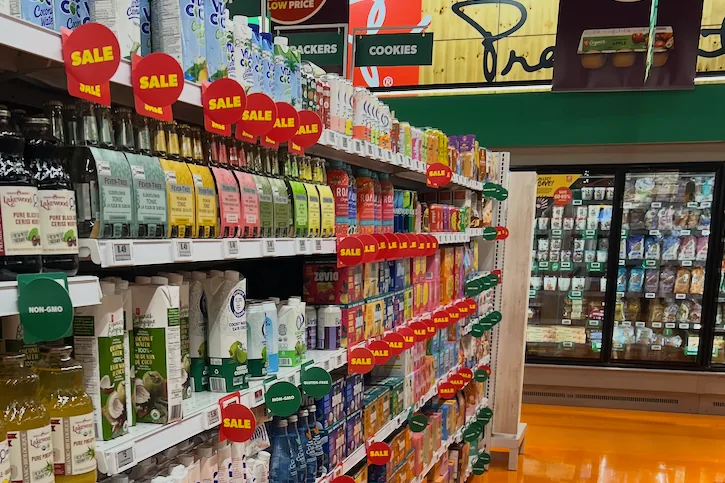
The panel repeatedly returned to visibility. A new brand may win a listing and still occupy a small, easily overlooked part of a crowded category. But giving it more space also requires judgment: can shoppers easily see, approach and reach the product?
A study published in PLOS One in April 2026 illustrates that distinction. In a 12-week comparison conducted in one supermarket in 2022, removing five freestanding displays increased the aisle’s share of total store revenue, despite fewer product facings. The study examined aisle-level performance rather than individual SKU demand, but it highlights why accessibility belongs alongside visibility when evaluating merchandising. Read the open-access study.
Before changing the assortment or cutting the price, establish whether:
- The SKU was available on the selling floor.
- Shoppers could easily find and reach it.
- The placement matched the agreed plan.
- Pricing and signage were correct.
- The planned display, demo or promotion actually happened.
- Staff had the information needed to explain the product.
- Stockouts or delivery delays interrupted the evaluation period.
The question is more precise than whether a product sold well: under what conditions did it sell?
Answering that helps distinguish an execution problem from a product, price or assortment problem. It gives the brand and retailer a clearer basis for deciding what to change before the next order.
How do you distinguish sell-in from sell-through?
Sell-in measures sales into a retail or distribution account. Sell-through concerns movement onward to the shopper. A large opening order demonstrates that inventory entered the channel; consumer sales and subsequent inventory movements help establish whether that inventory is moving successfully through it.
The panel warned against loading a store with more product than it could reasonably sell. The concern was practical: unsold cases become the retailer’s problem and make the next conversation harder.
For a brand selling through a distributor, the distinction requires extra care. A shipment to the distributor does not establish delivery to individual stores. Delivery to a store does not establish a shopper purchase.
Keep those stages visible:
| Stage | What it establishes | What still needs checking |
|---|---|---|
| Distributor orders from the brand | Upstream purchasing activity | Allocation and onward shipments |
| Retailer receives stock | Inventory reached the account | Placement and shopper purchases |
| Point-of-sale sales occur | Shoppers bought the product | Remaining inventory and replenishment needs |
| Retailer reorders | The account wants more stock | Whether the order reflects sustained demand, a promotion or another inventory decision |
When retailer point-of-sale data are unavailable, use reorder patterns, stock checks and account conversations as directional evidence. Be explicit about the limits: an overdue reorder is a reason to investigate.
It may indicate weak sell-through. It may also reflect an oversized opening order, an ordering issue or a change in assortment.
What makes a secondary display worth repeating?
A secondary display is worth repeating when it produces enough additional commercial value to justify its stock, space and execution costs. Evaluate total SKU performance, remaining inventory and the period after the display ends. Sales taken from the display alone cannot establish how much purchasing it added.
The panel’s examples of cross-merchandising were grounded in how people use products: olive oil near tomatoes or peanut butter near apples. Taking the idea a little further, imagine ice cream next to pickles when a baby boom is on the horizon.
That suggests a useful starting point for a brand’s proposal. Define the shopper occasion the placement serves. Explain why the combination helps someone make a purchase decision.
Then establish what success will look like.
Compare the activity with an appropriate baseline and, where possible, similar stores without the intervention. Record price changes, demos, stockouts and other promotions that could explain the result. A simple before-and-after comparison is useful, but it cannot isolate every cause.
Review three outcomes:
- Sales: Did total SKU sales improve, including the regular shelf?
- Economics: Did the additional contribution justify the activity’s costs?
- Continuation: What happened to sales, inventory and orders after the display ended?
For the retailer, category performance also matters. A brand can gain sales by drawing purchases away from another product without expanding the category.
This is a stronger conversation to bring to a buyer: a clear hypothesis, an executable test and a shared basis for deciding what to do next.
Why does replenishment belong in the merchandising plan?
Replenishment belongs in the merchandising plan because a successful display, demo or promotion can change how quickly a product sells. The opening quantity, reorder timing and delivery schedule need to reflect that activity. Otherwise, the store risks running out during the promotion or carrying excess stock after it ends.
A 2024 study published in the European Journal of Operational Research tested ordering decisions with 140 participants. Participants who knew about upcoming promotions made better ordering decisions, reducing costs while maintaining service levels. The study also identified a tendency to overorder after a promotion. These were laboratory findings, but they support a practical principle: share promotional plans with the people responsible for replenishment before the activity begins. Read the study abstract.
For brands, distributors and retailers, that means agreeing on:
- An opening quantity based on expected sales during the activity.
- Who will monitor sales and remaining stock.
- When another order must be placed, given delivery lead times.
- Who will move available backroom stock onto the shelf or display.
- When to reduce replenishment as the promotion ends.
The panel’s example of 100 cases versus 30 brings this into focus. A smaller opening quantity can make sense when the team can replenish quickly. If the next delivery takes longer, the plan needs enough stock to cover that gap.
The goal is to keep the product available throughout the selling opportunity without leaving the retailer with an avoidable surplus.
A merchandising plan needs to include a clear replenishment plan: who reorders, when, and how stock reaches the shelf.
How should brands combine retail experience with data?
Retail experience should help brands and buyers identify promising ideas, while data should help them test those ideas and decide what to repeat. Agreeing on the hypothesis and success criteria in advance makes it easier to learn from both strong and disappointing results.
The panel gave considerable weight to time spent in stores, conversations with staff and experienced merchant judgment. Those inputs deserve a place in the decision.
A sales report does not tell you everything about whether the packaging fits the shelf, the message is legible or the display makes sense in that location.
The next step is to make the judgment testable.
An experienced merchant may believe a product will perform better near a complementary category. Translate that belief into a specific placement, a defined period, a stock plan and a review.
Avoid changing the explanation after the result is known. If the test disappoints, determine whether the hypothesis failed or the agreed execution never happened.
For emerging brands, this offers a practical approach to expansion. Use a manageable group of stores to learn whether the product, support and replenishment process can work together. Then expand with a clearer understanding of the resources required.
What role should a Canadian brand story play?
A Canadian brand story can give shoppers a reason to notice and consider a product. Make that story specific, accurate and easy to understand, while continuing to compete on the product’s usefulness, taste, price and availability.
The CHFA discussion emphasized founder stories, local roots and the opportunity to make those details visible through packaging, displays and digital channels.
External research supports interest in buying Canadian, with important qualifications. In a September 2025 Ipsos poll, 56% of Canadians reported buying more Canadian products or investments in the previous two weeks because of Canada-U.S. relations. That is self-reported behaviour across a broad category of purchases, rather than a grocery sales measure or a September 2026 estimate. Ipsos research.
The practical opportunity is to give the retailer a story that can be used consistently: who founded the business, where the product is made and what makes it relevant to the shopper.
QR codes can provide room for more detail. GS1’s Sunrise 2027 initiative supports retail adoption of 2D barcodes that can connect shoppers to richer product information. That establishes a technical opportunity; it does not establish a sales increase from adding a code. GS1 guidance.
Put the essential buying information where shoppers can see it. Use the digital destination to answer deeper questions, and measure whether people use it.
What should a brand bring to the next retailer meeting?
Bring a proposal the retailer can evaluate and execute: category fit, an appropriate quantity, confirmed support, replenishment responsibilities and a review date. Preparation should reduce the work required to turn the proposal into an activity on the selling floor.
One of the clearest themes in the panel was respect for merchant capacity. Buyers and store teams have limited time. A request for space becomes more useful when it arrives with the decisions and responsibilities already considered.
A concise activation brief can cover the following:
| Decision | What to bring |
|---|---|
| Why this product here? | Shopper occasion, category fit and relevant evidence |
| What will happen in-store? | Agreed placement, dimensions, signage and dates |
| How much stock is appropriate? | Opening quantity, case pack, shelf life and demand assumptions |
| What support is committed? | Demo schedule, materials, promotion and named contacts |
| How will replenishment work? | Lead time, stock checks and escalation responsibility |
| How will performance be reviewed? | Sales, inventory, costs and next-order discussion |
Clarify the handoffs as well. The brand may own the campaign, the broker the commercial relationship, the distributor the delivery and the retailer the shelf. Each party needs to know which action belongs to them.
Where does Commerce Operations fit in growing retail accounts?
Growing a retail account means helping the retailer choose the right products, sell through the stock and reorder with confidence. Commerce Operations connects that commercial work to account history, demand, available inventory and order processing, so the team can follow through on what it sells.
Grabb is Commerce Operations software for CPG brands, distributors and manufacturers. It acts as a System of Action across the systems the business already uses, connecting signals to priorities and configured work.
Give field teams a reason to visit and a clear next action
A productive retail visit starts before the rep walks into the store. Which products has the account stopped ordering? Is replenishment overdue? Is there an assortment opportunity worth discussing? What happened on the last delivery?
Those signals give the rep a starting point. The store visit adds the physical context: a misplaced product, an oversized display, a pricing issue or staff who need help explaining the brand.
The rep can then recommend an action that fits the account: adjust the quantity, support a demo, introduce a relevant SKU or resolve a delivery problem before asking for another order.
Grabb’s field sales guide explains how account history, product penetration and reorder signals can guide that work.
Match the commercial promise to the inventory plan
Before committing to a display or promotion, sales and operations should agree on what they can supply, when it can arrive and how replenishment will work.
The panel’s 100-case versus 30-case example captures that decision. Thirty cases may be appropriate when expected sales and replenishment timing support that quantity. A larger opening order needs a reason grounded in the store’s selling conditions.
Grabb’s demand capabilities provide context such as reorder cadence, seasonality and changes in SKU velocity. Teams can use that context alongside available stock, delivery lead times and retailer feedback to decide what to offer and how to support it.
Stop making the retailer do your order-entry work
The old portal-first approach asks the retailer to adapt to the supplier: create another login, navigate another catalogue and follow another ordering process.
When a buyer has already created a PO in their own system, requiring them to re-enter it in a supplier portal makes them do the work twice. A bloated ordering flow can turn a routine replenishment into another administrative task.
It can also leave important commercial questions unanswered. Why should this store carry the new SKU? How does it fit the assortment? What quantity makes sense? What support will the brand provide?
A catalogue and checkout cannot carry that conversation on their own. Keep a direct path to someone who can explain the brand’s value, answer questions and help the retailer build an order that fits.
Our position is simple: retailers should be able to place an order through the channels they already use, while the supplier takes responsibility for processing it efficiently.
Grabb’s order automation reads orders from configured sources such as email, PDFs and spreadsheets, matches customers and products, and validates pricing and business rules. Standard orders move through supported workflows; exceptions go to people for review. ERP posting depends on the integration and configuration.
That gives the commercial relationship room to do its job: help the retailer understand the product, make a sound buying decision and sell it successfully.
For your next retail activation, connect three decisions before the first shipment leaves: what the rep will help the store achieve, how inventory will support that promise and how the next order will move.
Winning shelf space starts the relationship. Helping the retailer sell through and reorder is how you develop it.
Source note: Panel themes are paraphrased from attendee notes of CHFA NOW Toronto 2026, The Power of Merchandising session on September 25, 2026. The recommendations and critique of portal-first ordering are Grabb’s editorial perspective, not attributed speaker statements. Product capabilities are linked to Grabb’s documentation.
Sources
- The Power of Merchandising (CHFA NOW Toronto 2026 schedule): CHFA NOW
- When merchandise crowds the aisle and carts crowd the shopper: Joint effects on sales: PLOS One
- Multi-period ordering decisions in the presence of retail promotions: European Journal of Operational Research
- Buy Canadian research (September 2025): Ipsos
- Sunrise 2027: GS1
- Field Sales Software for CPG and Distribution: Grabb
- Demand: Grabb
- Order automation: Grabb
Keep reading

Systems & Processes
Consumers Want More Value. That Doesn't Mean CPG Brands Need More Promotions.
Consumers are looking harder for value, but that does not automatically mean CPG brands should respond with more promotions.
Systems & Processes
B2B Commerce Should Learn From B2C. Not Copy It.
B2B should copy B2C's obsession with reducing friction, not its assumption that every order should begin in a storefront.
Systems & Processes
How to Automate PDF Purchase Orders Into QuickBooks Without Manual Data Entry
A customer emails a PDF purchase order. Grabb reads it, matches the customer and products, validates quantities and pricing, and sends the approved order into QuickBooks.
From insight to action
Your data already knows what changed.
Grabb turns customer, product, order and operational signals into a prioritized list of what your team should do next.