
Systems & Processes
Before You Hire Another Salesperson, Look at the Data You Already Have
Before adding sales headcount, manufacturers and distributors should ask whether existing customer and order data can better identify account risk, growth opportunities and future demand.

The short answer
Before hiring another salesperson, manufacturers and distributors should check whether existing customer and order data can identify account risk, growth opportunities and demand changes. Often the constraint is not capacity: it is knowing where the current team should intervene.
In this article
Two inbound conversations landed in my inbox recently.
Different companies. Different industries. Almost the exact same question.
One company manages large OEM accounts. Their sales team still uses spreadsheets to figure out which customers might be at risk and which could be ready for a bigger program.
The other is a distributor looking for better sales insights and forecasting. They were considering hiring another salesperson, but before doing that, they wanted to know what they could get from the sales data already sitting in QuickBooks.
That second question stuck with me:
Before we put another salesperson on, are we getting everything we can from the data we already have?
I think a lot more manufacturers and distributors should be asking it.
Because sometimes the problem isn’t that you need more sales capacity.
Sometimes your existing team just doesn’t know where to put it.
The spreadsheet is usually a symptom, not the problem
I have nothing against spreadsheets.
They’re flexible. Everyone knows how to use them. And when a company is smaller, they work.
You export sales. Sort customers. Compare this year to last year. Look at products. Add a few formulas. Maybe flag some accounts in red.
The problem starts when the questions get harder.
- Which customers are slowing down relative to their own normal buying cycle?
- Which account hasn’t reordered something it normally buys every six weeks?
- Which customer is growing, but only across part of your assortment?
- Which accounts could support another product line?
- Which changes are normal seasonality and which ones deserve a call?
- Which products are gaining enough momentum that purchasing should know about it?
Now somebody has to continuously compare customers, products, orders, timing, history and business context.
That is when the spreadsheet stops being the solution and becomes evidence of a missing operating process.
Do you need another salesperson, or does your sales team need better leverage?
This is the part I find interesting.
When growth gets harder to manage, adding another salesperson feels like a logical answer.
More accounts. More products. More territories. More work.
So add another person.
Maybe.
But before adding headcount, I would want to understand why the current team is at capacity.
If reps spend part of every week figuring out who to call, searching through order history, comparing spreadsheets and trying to remember which customer normally buys what, that isn’t really selling.
It’s preparation for selling.
There is a big difference.
A rep with 300 accounts should not have to inspect 300 accounts to discover that only 12 materially changed this week.
The system should be able to say:
These are the accounts that changed. Start here.
That doesn’t replace the rep.
It gives the rep leverage.
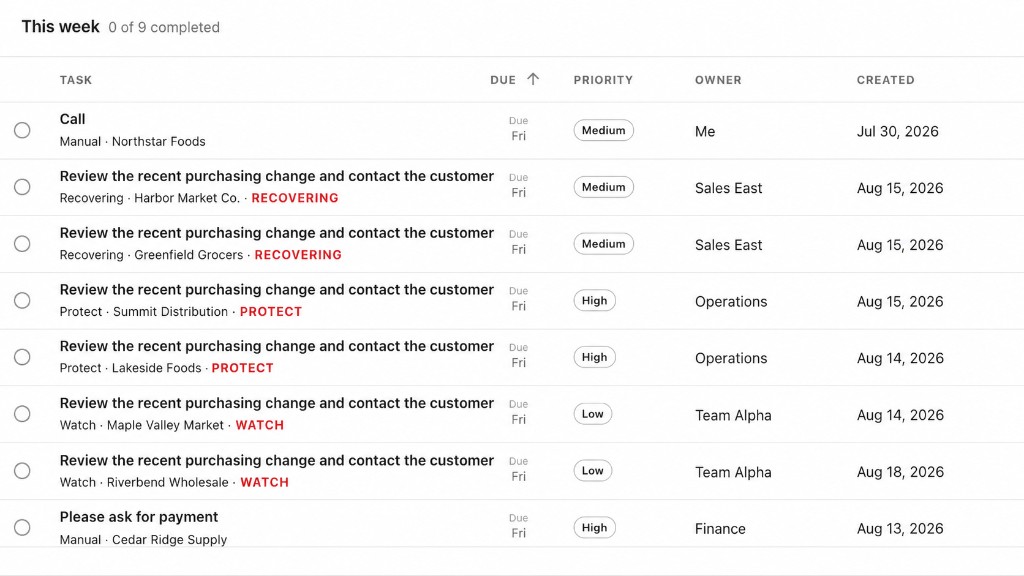
Instead of inspecting every account, start with the ones that changed.
What should your sales data actually be telling you?
Sales analytics usually starts with reporting.
Revenue by customer. Revenue by product. Sales by month. Margin. Growth. Top accounts. Rep performance.
Useful, yes.
But most of those answers describe what already happened.
For sales execution, I think the more interesting questions are about change.
Which customers are behaving differently?
Every established customer creates a pattern over time.
- How often they order.
- What they normally buy.
- How much they normally buy.
- Whether their purchases are seasonal.
- Which products tend to move together.
- How their purchasing has been changing.
Once you understand that pattern, you can start looking for deviations from it.
Imagine a customer that normally orders every 35 to 45 days.
It’s now day 62.
Nothing has technically been lost yet. The customer hasn’t called to cancel. There may be no opportunity sitting in the CRM.
But something changed.
That’s a sales signal.
Or maybe the customer is still ordering at the same frequency, but quantities have been declining for three consecutive cycles.
Different signal.
Or they’re buying four products from a category where similar customers normally buy seven.
Potential expansion signal.
This is where transaction data becomes much more interesting than another monthly sales report.
The question moves from:
What were my sales last month?
to:
What changed, and where should someone act?

Prioritized recommendations turn customer and product changes into a short list of next actions.
Account risk is rarely a single event
We use the word “churn” a lot in software because subscription businesses make churn easy to see.
A customer cancels.
For a manufacturer or distributor, it is often messier.
Customers don’t necessarily send an email saying:
We’ve decided to reduce our purchases from you by 38%.
They just start buying differently.
An order arrives later.
Then another.
A SKU disappears.
Order quantities decline.
The customer keeps buying, but the relationship is getting smaller.
By the time the decline becomes obvious in a quarterly report, a lot may already have happened.
That’s why I prefer thinking about changes in buying behavior rather than simply asking whether a customer has churned. We wrote more about that in how to predict customer churn using QuickBooks data.
The useful signal happens before the final outcome.
And that is when the sales team still has something to do about it.
Growth signals work the same way
The opposite is also true.
Your best expansion opportunities aren’t always sitting in a CRM pipeline.
Sometimes they’re already visible in customer behavior.
- An account starts ordering more frequently.
- A specific category accelerates.
- A customer buys one part of an assortment but consistently ignores products that naturally fit beside it.
- A customer expands volume in one location, program or territory.
None of those automatically mean “upsell this customer.”
Context still matters.
But they tell the rep where it is worth looking. For more on that motion, see our guide to cross-selling and upselling.
That’s an important distinction.
I don’t think the goal of AI or analytics should be to magically decide what a salesperson should say to every customer.
The first job is simpler:
Reduce the universe of things a person needs to investigate.
- From hundreds of accounts to the ones that changed.
- From thousands of SKUs to the combinations that matter.
- From every possible opportunity to the few worth reviewing now.
That’s already a huge shift.
Can QuickBooks data actually help with sales forecasting?
Yes, but the important part isn’t generating another forecast chart.
Transaction history in systems such as QuickBooks contains real information about what customers bought, when they bought it, how much they bought and how that behavior changed over time.
That history can help establish patterns around customer demand, product velocity, seasonality and reorder timing.
The limitation is that the accounting system was built primarily to record transactions.
It isn’t necessarily going to tell the sales rep:
Customer A is outside its normal reorder cycle.
Or tell the sales director:
These accounts are driving most of the expected slowdown next month.
Or tell purchasing:
Demand for these products is beginning to move differently.
The data may already exist.
The operating signal doesn’t.
That gap matters.
Sales forecasting gets much more interesting when purchasing can use it too
This was the part of the second conversation that really got my attention.
They weren’t only looking for better sales insights.
They wanted to sell more effectively and purchase more effectively based on the same forecast.
That’s where this stops being a sales analytics problem.
A forecast used only to tell a sales manager whether the team might hit a target is useful.
But demand touches much more than the sales target.
If customer behavior suggests demand is changing, that can eventually affect:
sales priorities → expected orders → purchasing → stock → fulfillment → future sales.
These decisions are connected whether your software connects them or not.
And this is where I think a lot of growing product businesses get stuck. This is also why inventory forecasting gets more useful when sales and purchasing share the same demand signal.
Sales has one spreadsheet.
Purchasing has another.
Finance has the accounting system.
Operations has its own numbers.
Everyone is looking at a slightly different version of the same commercial reality.
Then people become the integration layer.
Meetings, exports, emails and spreadsheets reconnect everything.
It works.
Until it doesn’t.
Systems of record are necessary. They just have a different job.
I’m not in the camp that thinks businesses should replace all their existing systems with one giant AI platform.
Quite the opposite.
QuickBooks should be good at being QuickBooks.
Your ERP should run the processes it was designed to run.
Your ecommerce platform should handle ecommerce.
Your CRM should manage the work you decide belongs in your CRM.
As a company grows, having several systems is normal.
The harder problem is what happens between those systems.
Who notices that a customer changed?
Who decides that the change is important?
Who connects that signal to the products involved?
Who determines whether it requires a sales action, a purchasing decision or simply monitoring?
And who follows up?
Systems of record are excellent at preserving what happened.
The opportunity now is building a better system for what happens next. That gap between recording and deciding is the same problem we wrote about in why your commerce stack can’t generate decisions.
More dashboards are not the answer
This is where I think the word “analytics” sometimes sends companies in the wrong direction.
They say they want better analytics, so the natural response is another dashboard.
- More charts.
- More filters.
- More ways to slice the data.
But if the person still needs to open the dashboard every morning, inspect 15 charts, interpret what changed and then create their own list of actions, we’ve only improved the inspection process.
We haven’t changed the job.
For me, the better question is:
What should the system monitor so the person doesn’t have to?
- If an account moves outside its normal buying pattern, surface it.
- If an expected reorder doesn’t happen, surface it.
- If a customer has an obvious assortment gap worth investigating, surface it.
- If demand is changing enough to affect a purchasing decision, surface it.
Then let the person apply judgment.
That is much closer to how I think AI should be used in commerce operations.
Not “give me more information.”
Watch what changes and tell me what deserves attention.
What I would want to know before hiring the next salesperson
If I were running a manufacturer or distributor and thought we needed another sales rep, I would still consider the hire.
But first I would ask:
- How many accounts can the current team realistically cover?
- How much of their week is actually spent selling?
- How much time goes into finding the next account to work on?
- Can we identify customers slowing down before the decline becomes obvious?
- Can we identify expansion opportunities from actual purchasing behavior?
- Can we distinguish normal seasonality from unusual change?
- Do sales and purchasing have a common view of expected demand?
And perhaps most importantly:
Does every salesperson need to inspect everything, or can the system tell them what changed?
If those answers aren’t clear, I would solve that visibility-to-action problem before assuming headcount is the only constraint.
This is the problem we’re building Grabb around
These two conversations caught my attention because they describe exactly where we believe Commerce Operations is going.
Grabb sits across the systems a product business already uses and watches customers, products, orders, demand and other operational context for changes that may require action.
The goal isn’t to replace the accounting system, ERP or salesperson.
It’s to close the gap between the transaction and the next decision.
- A customer slows down.
- A reorder is missed.
- An account has room to expand.
- Demand begins to move.
- Something needs attention.
Instead of asking someone to continuously search for those changes, the system should find them, prioritize them and help move the appropriate work forward. That is also what Sales Execution is built to support day to day.
Systems of record tell you what happened. Grabb helps run what happens next.
If you want a concrete example of what that looks like in practice, start with the Pompco customer story.
One last thought
Hiring another salesperson might be exactly the right decision.
But adding people to a process that still depends on manual account inspection also multiplies the manual work.
More reps means more accounts being managed, more spreadsheets, more follow-up, more coordination and potentially more inconsistency in how opportunities are found.
So before adding the next person, I think there’s a simpler question worth asking:
Are we short on salespeople, or are we short on signal?
The answer might change where you invest next.
Keep reading

Systems & Processes
Can You Automate Order Entry in QuickBooks Desktop? Yes, Here's How.
Yes. QuickBooks Desktop order entry can be automated without replacing QuickBooks.

Systems & Processes
How to Predict Customer Churn Using QuickBooks Data
When you’re running a growing business, the last thing you want is to lose a good customer without warning. But if you’re like most QuickBooks users, you might be sitting on early warning signs and no
Systems & Processes
B2B Commerce Should Learn From B2C. Not Copy It.
B2B should copy B2C's obsession with reducing friction, not its assumption that every order should begin in a storefront.
From insight to action
Your data already knows what changed.
Grabb turns customer, product, order and operational signals into a prioritized list of what your team should do next.